Sparks of the One Light
In the previous chapter, The Universe: One Force, One Law, we spoke of the one principle behind all things: the light of Ein Sof, and the two forces that emerged when it withdrew, the Will to Bestow and the Will to Receive, upheld by that Light. These forces do not belong to some distant point of origin, sealed off in the past. They cascade through every world that followed, unbroken, and they live now in each individual exactly as they live in the whole of reality, the same structure repeated at every scale, from the purest emanation down to the material world, from the largest thing there is down to a single human being.
This truth stands at the centre of everything. Every great human endeavour, whether it knows it or not, moves toward an understanding of it. Every field of inquiry, every innovation, every small and prosaic discovery explores our existence and unwittingly advances the same relationship between our world and the principle that drives it forward. Mathematicians, poets, philosophers, scientists, cosmologists, separated by continents and by centuries, often with no possibility of direct contact, have each arrived, by nothing more than their own devotion to their own field, at this same eternal ground. Newton once wrote, “If I have seen further, it is by standing on the shoulders of giants.” Every figure gathered in this chapter is one of those giants, and what follows lets us see a little further because of what a stranger, centuries before or an ocean away, had already glimpsed and set down.
This chapter gathers a number of individuals who left behind writing, a fragment, a sentence, an observation recorded by someone who heard them say it, in which the understanding this site has been tracing shows through plainly. Almost none had any contact with Kabbalah at all. And yet what they say, set beside what Kabbalah teaches, needs no translation to be recognised.
The parallels lay bare.
What they were each reaching for cannot fully be contained in words, but the endeavour of the human race, pressing ever forward, discovers more of this truth with every age. Serious minds, in every sphere of knowledge, have pushed against the same frontier, pressing against the very border of existence and understanding, and some, however briefly, however imperfectly, have come away holding a piece of what lies beyond it.
What follows was not written for a Kabbalistic reader, and none of it arose from within a Kabbalistic framework. It surfaces on its own, as freely as the air we breathe, as close to us as our own heartbeat, wherever someone has looked closely enough and asked honestly enough.
What follows is divided into four fields of human endeavour: the poets and writers; the philosophers and thinkers; the scientists, mathematicians, and cosmologists; and the ancients and visionaries. Within each, a small number of voices are drawn from as broad a palette as history allows, women and men, ancient and modern, so that by the end of this chapter it is not one culture or one century making this claim, but every one of them, independently, without knowledge of the others. It makes no difference what name is given to it, what background produced the thinker, what epoch or hemisphere they belonged to. The destination is the same, regardless of the road taken to approach it.
The geologist, the chemist, the inventor, the writer, the thinker, the poet: each comes to this in their own way, by ardent work, by study, by patient and studious observation, often without realising that they have stepped onto the same Great Highway, one that leads ever upward. And bound up in that ascent is a further truth we will return to in the section that follows: that the higher nature innate within all humanity must always claim victory over the lower, a spiritual law of advancement that belongs to the whole of humanity, and to every person within it, who must overcome their own base nature and replace it with the new.
What follows are the words of those who have gone before, who have arrived, each by their own road, at the same frontier.
The Poets & Writers
Poetry reaches a truth before argument can catch up to it. A poet does not set out to prove that reality is layered, or that the self is larger than it appears, or that time does not move the way it seems to. A poet simply looks closely enough and for long enough that the observation arrives on its own, carried by an image rather than a proof, and the reader feels it before understanding why. What follows is a small collection of those who looked this closely, working centuries and continents apart, in languages and forms that owed nothing to one another.
William Wordsworth (1770 to 1850)
Wordsworth spent much of his life in the English Lake District, and it was there, watching the natural world with an attention few poets before him had given it, that he came to write his Ode: Intimations of Immortality, a meditation on a loss he could feel but not yet name, the sense that something known clearly in childhood grows faint with every year that follows.
“Our birth is but a sleep and a forgetting: the Soul that rises with us, our life’s Star, hath had elsewhere its setting, and cometh from afar. Not in entire forgetfulness, and not in utter nakedness, but trailing clouds of glory do we come from God, who is our home. Heaven lies about us in our infancy.” — Ode: Intimations of Immortality from Recollections of Early Childhood, 1807
Wordsworth is describing, without any Kabbalistic training at all, the descent of the soul into concealment, arriving trailing what it once knew only to lose it by degrees as the world closes in. In a sonnet written the same year, he gives the poem in full, naming what does the closing.
“The world is too much with us; late and soon, getting and spending, we lay waste our powers: little we see in Nature that is ours; we have given our hearts away, a sordid boon! This sea that bares her bosom to the moon, the winds that will be howling at all hours, and are up-gathered now like sleeping flowers, for this, for everything, we are out of tune; it moves us not. Great God! I’d rather be a Pagan suckled in a creed outworn; so might I, standing on this pleasant lea, have glimpses that would make me less forlorn; have sight of Proteus rising from the sea; or hear old Triton blow his wreathed horn.” — The World Is Too Much With Us, 1807
Between the two poems Wordsworth gives both halves of the same teaching, the soul arrives trailing its origin, and the getting and spending of ordinary life is precisely what wastes the powers that origin gave it, so thoroughly that he would rather take up the myths of a vanished, outworn faith than remain deaf to the sea and the wind as they actually are. This is the sleep of humankind, and the forgetting he names is the same forgetting that stands between a person and adhesion {Dvekut, דבקות} with the source they came from.
William Blake (1757 to 1827)Blake worked largely outside the literary establishment of his own time, supporting himself as an engraver while producing a body of prophetic poetry his contemporaries found difficult to place. In Jerusalem, his speaker records the Saviour appearing to him and speaking these words.
“Awake! Awake O sleeper of the land of shadows, wake! Expand! I am in you and you in me, mutual in love divine, fibres of love from man to man thro’ Albion’s pleasant land.” — Jerusalem: The Emanation of the Giant Albion, 1804 to 1820
And in a letter to his friend Thomas Butts, Blake described how his own sight had opened in stages.
“Now I a fourfold vision see, and a fourfold vision is given to me, tis fourfold in my supreme delight, and threefold in soft Beulah’s night, and twofold always, may God us keep from single vision and Newton’s sleep.” — Letter to Thomas Butts, 22 November 1802
Blake had no contact whatsoever with Kabbalah, and yet the fourfold sight he describes maps with real precision onto the four worlds, Assiyah, Yetzirah, Beriah and Atzilut {the four worlds, עולמות}, degrees of sight opening in stages while the world itself remains unchanged and only the eye that meets it is transformed. The second half of the passage is the more tender of the two. Beulah, in Blake’s own private mythology, is the soft borderland of rest and dream, neither the fullest waking vision nor its total absence, a place of respite where the soul is permitted to gather itself before rising again. Twofold sight, by contrast, is the ordinary way of seeing the world in pairs and opposites, subject against object, self against other, and single vision is the flattest and most sleeping state of all, the world seen as dead matter and nothing more, which is what Blake means by Newton’s sleep. What makes the passage so moving is that Blake is not asking to leave the lower states behind entirely. He asks only that they be kept in their place beneath the higher ones, so that the twofold and even the single vision remain available to him without ever being mistaken for the whole of what can be seen.
Walt Whitman (1819 to 1892)
Whitman worked for most of his life as a journalist in New York, and wrote as a man for whom the ordinary boundary of the self had quietly given way. Earlier in Song of Myself he writes of containing every life at once.
“I am the man, I suffered, I was there. Agonies are one of my changes of garments; I do not ask the wounded person how he feels, I myself become the wounded person.” — Song of Myself, from Leaves of Grass, 1855
And near the poem’s close, in the section that gives the conclusion that follows from it, he writes the passage in full.
“Do I contradict myself? Very well then I contradict myself, I am large, I contain multitudes. The spotted hawk swoops by and accuses me, he complains of my gab and my loitering. I too am not a bit tamed, I too am untranslatable, I sound my barbaric yawp over the roofs of the world.” — Song of Myself, from Leaves of Grass, 1855
Read together, the two passages show the same movement twice, first the self dissolving into every other self it meets, then the self recognising that this dissolving was never a loss but its true size all along, so unmeasured by ordinary logic that even a passing hawk seems to accuse it of excess. This is a plain statement of the unification {Yichud, יחוד} that Kabbalah teaches lies beneath every apparent division.
Emily Dickinson (1830 to 1886)
Dickinson spent nearly the whole of her adult life in her family home in Amherst, Massachusetts, and published almost nothing during it, yet in private she wrote some of the most compressed lines in the language on the nature of the interior world.
“The Brain, is wider than the Sky, for, put them side by side, the one the other will contain, with ease, and You beside. The Brain is deeper than the sea, for, hold them, Blue to Blue, the one the other will absorb, as Sponges, Buckets, do. The Brain is just the weight of God, for, Heft them, Pound for Pound, and they will differ, if they do, as Syllable from Sound.” — The Brain is wider than the Sky, circa 1862
In another poem, she names the interior world directly as a dwelling.
“I dwell in Possibility, a fairer House than Prose, more numerous of Windows, superior, for Doors.” — I dwell in Possibility, circa 1862
Between the two, Dickinson names the mind itself as the vessel {Kli, כלי} that receives, and finds it larger than the sky it perceives, deeper than the sea it can hold, and by her own final measure, weighed against God and found to differ only as a syllable differs from the sound that carries it, which is to say barely at all. This is precisely the relationship Kabbalah describes between a vessel and what it is built to hold, that the vessel is shaped by, and in its own way commensurate with, the very thing it receives.
Christina Rossetti (1830 to 1894)
Rossetti wrote Up-Hill as a dialogue between a traveller and an unnamed voice answering from further along the road.
“Does the road wind up-hill all the way? Yes, to the very end. Will the day’s journey take the whole long day? From morn to night, my friend. But is there for the night a resting-place? A roof for when the slow dark hours begin. May not the darkness hide it from my face? You cannot miss that inn.” — Up-Hill, from Goblin Market and Other Poems, 1862
No shortcut is offered, and none is wanted, and the traveller is assured that rest exists and cannot be missed once the road is walked to its end. Rossetti was writing as a devout Anglican, and the poem is usually read simply as a meditation on death and the promise of heaven, so the connection to any climb through the Kabbalistic worlds should be held lightly rather than pressed too hard. What can fairly be said is narrower and, for that, more solid: the poem’s central image, of an ascent that is long, unavoidable, and certain to end in arrival, echoes the plainest Kabbalistic teaching about spiritual effort, that the climb is real, that it is walked in full rather than shortcut, and that it does end. The reader is free to take the resemblance no further than that.
Alfred, Lord Tennyson (1809 to 1892)
Tennyson’s short poem Flower in the Crannied Wall takes a single flower pulled from a stone wall and asks what understanding it completely would actually mean.
“Flower in the crannied wall, I pluck you out of the crannies, I hold you here, root and all, in my hand. Little flower, but if I could understand what you are, root and all, and all in all, I should know what God and man is.” — Flower in the Crannied Wall, 1869
In Ulysses, written decades earlier, he gives the same restlessness a different shape, an old man long past his conquests who refuses to be still.
“Tho’ much is taken, much abides; and tho’ we are not now that strength which in old days moved earth and heaven, that which we are, we are, one equal temper of heroic hearts, made weak by time and fate, but strong in will to strive, to seek, to find, and not to yield.” — Ulysses, 1842
Tennyson returned to this same ground once more, and more directly than in either of the poems above, in a piece too often overlooked.
The sun, the moon, the stars, the seas, the hills and the plains,-
Are not these, O Soul, the Vision of Him who reigns?
Is not the Vision He, tho’ He be not that which He seems?
Dreams are true while they last, and do we not live in dreams?
Earth, these solid stars, this weight of body and limb,
Are they not sign and symbol of thy division from Him?
Dark is the world to thee; thyself art the reason why,
For is He not all but thou, that hast power to feel “I am I”?
Glory about thee, without thee; and thou fulfillest thy doom,
Making Him broken gleams and a stifled splendour and gloom.
Speak to Him, thou, for He hears, and Spirit with Spirit can meet-
Closer is He than breathing, and nearer than hands and feet.
God is law, say the wise; O soul, and let us rejoice,
For if He thunder by law the thunder is yet His voice.
Law is God, say some; no God at all, says the fool,
For all we have power to see is a straight staff bent in a pool;
And the ear of man cannot hear, and the eye of man cannot see;
But if we could see and hear, this Vision-were it not He?
— The Higher Pantheism, 1869
Taken together, the three poems give Tennyson’s fullest statement of the same principle from three angles: that the whole is legible in any single part of it truly understood, that whatever has once tasted this understanding cannot be made to stop reaching for it, and, most directly of all, that the entire visible world, sun and moon and the weight of a person’s own body, is sign and symbol of a single division between the soul and the thing it comes from, a division the poem locates nowhere but in the self’s own insistence on saying “I am I.” The first is the Kabbalistic principle of Root and Branch {Shoresh VeAnaf, שורש וענף}, that every effect carries the full imprint of its cause. The third states, in language a Kabbalist would recognise almost without translation, the doctrine of concealment {Tzimtzum, צמצום}, that what stands between a person and the Light was never distance but a veil drawn by the very faculty that lets a person feel separate at all.
Kahlil Gibran (1883 to 1931)
Gibran left Lebanon as a child and wrote much of his mature work in English. In Sand and Foam he offers a short passage on the self discovering its own true scale.
“It was but yesterday I thought myself a fragment quivering without rhythm in the sphere of life. Now I know that I am the sphere, and all life in rhythmic fragments moves within me.” — Sand and Foam, 1926
Later in the same book he returns to the image from another angle.
“They say to me in their awakening, you and the world you live in are but a grain of sand upon the infinite shore of an infinite sea. And in my dream I say to them, I am the infinite sea, and all worlds are but grains of sand upon my shore.” — Sand and Foam, 1926
The fragment discovering it was always the whole, and the grain of sand discovering it was always the sea, are the same movement Kabbalah describes in the Shattering of the Vessels {Shevirat HaKelim, שבירת הכלים} and their gathering back into unity, loss and recognition as two halves of one motion.
T. S. Eliot (1888 to 1965)
Eliot’s Four Quartets opens with a proposal about the nature of time itself.
“Time present and time past are both perhaps present in time future.” — Burnt Norton, from Four Quartets, 1936
The poem remains under copyright, so no more of it can be given here, but this single opening proposal is enough to show what it is reaching for, a picture of time as layered and simultaneous rather than sequential, close to what the Kabbalists know of the upper worlds, where past and future exist together rather than one following the other.
Mary Oliver (1935 to 2019)
Oliver returned throughout her work to attention itself as a form of waking, the plain act of noticing what stands in front of a person as the beginning of any real change in how they live. Her best known poems, among them Wild Geese and The Summer Day, remain under copyright, but the widely known question at the heart of the latter, what a person intends to do with their one wild and precious life, is itself a call to awakening {Hitorerut, התעוררות}, the same call Kabbalah makes to a person still asleep to their own state.
Dylan Thomas (1914 to 1953)
Thomas wrote from Wales in a voice thick with biblical cadence and physical imagery. One line from his early poetry has outlived almost everything else he wrote.
“The force that through the green fuse drives the flower.” — The Force That Through the Green Fuse Drives the Flower, from 18 Poems, 1934
In Fern Hill, written a decade later, he looks back on a childhood he knew even then could not last.
“Now as I was young and easy under the apple boughs, time let me play and be golden in the mercy of his means.” — Fern Hill, from Deaths and Entrances, 1946
And at the end of his life, writing to his dying father, he gave the refusal to sleep its most famous line.
“Rage, rage against the dying of the light.” — Do Not Go Gentle Into That Good Night, 1951
Across the three, Thomas gives the one force running through every living thing, the golden mercy of time that a child does not yet know is limited, and the refusal to surrender quietly once that limit is finally understood. Together they are as compact a statement of the one light {Ohr, אור} animating all existence, and the resistance to its withdrawal, as this chapter contains. These three poems remain under copyright in several jurisdictions, so the lines above are given at their original short length rather than extended further.
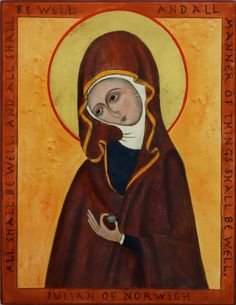
Julian of Norwich (1342 to circa 1416)
Julian was an English anchoress who, during a severe illness in 1373, experienced a series of visions later set down as Revelations of Divine Love, the earliest surviving book in English known to have been written by a woman.
“And in this he showed me a little thing the quantity of a hazelnut, lying in the palm of my hand, and it was as round as any ball. I looked upon it with the eye of my understanding, and thought, what may this be? And it was answered generally thus, it is all that is made. I marvelled how it might last, for I thought it might suddenly have fallen to nothing for littleness. And I was answered in my understanding, it lasts and ever shall, for God loves it, and so have all things their beginning by the love of God.” Revelations of Divine Love, circa 1395
In this small vision Julian saw three things at once. God made it. God loves it. God preserves it. Nothing in the object itself explains why it should endure. The only cause given is love, offered before anything is asked of it and without condition.
The Jewish mystical tradition has a name for this exact movement, Chesed, the first outward flow of divine love in the Kabbalistic map of creation, generosity that pours itself into the world before the world has done anything to earn it. Julian’s hazelnut, held together by nothing but that same kind of love, is an English anchoress arriving centuries later at the same intuition through her own tradition. Existence itself, in both accounts, is not a neutral fact. It is a gift continually renewed.
Julian’s writings are foundational to English mysticism and Christian theology. You can explore the full original text and modern translations of this visionary work via the Renovare library. If you are in the UK, you can also learn more about her life and her surviving anchorhold cell at the St Julian’s Church site in Norwich.esting on nothing but loving-kindness {Chesed, חסד}, the same force Kabbalah names as the first outward movement of bestowal.